

On Aug. 10, Meta’s CEO Mark Zuckerberg unveiled Muse Glimmer — a new AI model released under an open source licence — and announced that the weights of its flagship model, Muse Spark, would follow.
Set “Meta” beside “open” and many will sense a mismatch: How does a company opaque about account reach and feed rankings start flying the flag for open source?
The reason is simple: Meta sells attention, not models.
Meta’s main money-maker is not renting computing power. What it wants most is to maximise user lingering time.
The tech giant’s models are honed on questions such as which turns of phrase make you scroll a little longer and which copy keeps a given audience glued. By going open, Meta enlists developers the world over to help with tuning. The models get stronger; the products get stickier.
This is a maxim the tech industry swears by: “commoditise the complement”. Whatever is sold, open up the complementary pieces.
Take Taiwan’s TAIDE, or Trustworthy AI Dialogue Engine, model for example. It was built by taking Llama and training it further on Taiwanese-language data. Without spending a farthing, Meta gained a local edition of its model.
Why does Meta need to “return” to open source? Easy. Because it visited once before.
A few years ago, Meta released Llama, but kept a card up its sleeve: Use it freely as long as monthly active users number under 700 million; cross that line, and a separate licence and negotiated terms are needed. Naturally, Apple was never going to build Siri on terms someone else could rewrite at will. In the end, it paid Google for a partnership instead.
Zuck has now proclaimed a return to open source as the next ground he means to take is the always-on AI assistant.
Chat with an AI only occasionally, and it is impossible to tell whether the machine at the other end is a laptop or a data centre. But an assistant living in a pair of smart glasses or a mobile device — recognising a face here, a street there — must process every frame it sees and every waveform it hears on the spot. A round trip to the cloud is too slow. This is why it must be paired with an on-device model.
Until now, the world’s leading open-weight models have scarcely had a U.S. lab among them. That gap is Zuck’s real battlefield.
Understand Meta’s game, and the position we occupy within it is crystal clear.
Paying no subscription for AI does not mean it comes free. We pay in attention, and in the traces every prompt leaves behind. Those traces are material for tuning the model — and material for tuning us.
The good news is that this wave of openness offers options. A model good enough for everyday use can now run on our own machines: no internet connection required, and no more paying in attention.
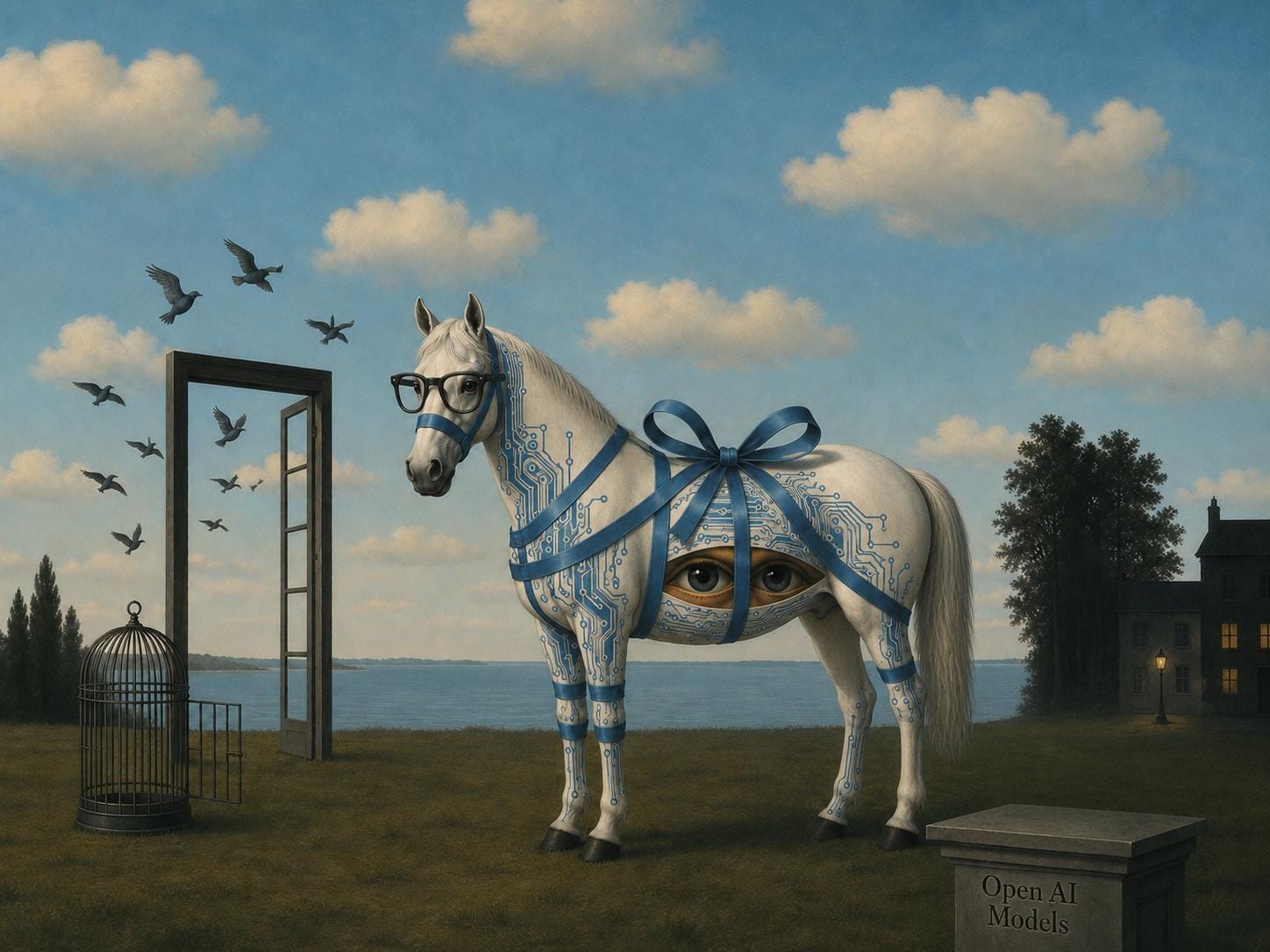
Zuck hands us the gift that ostensibly keeps on giving. But we can accept the gift and use it as a way out. After all, an AI model under open licence means we are beholden to no tech giant, and control of the data is ours again.
Cool image, be wary of gifts, lest you end up like the ancient Greeks.
I love you Audrey!