

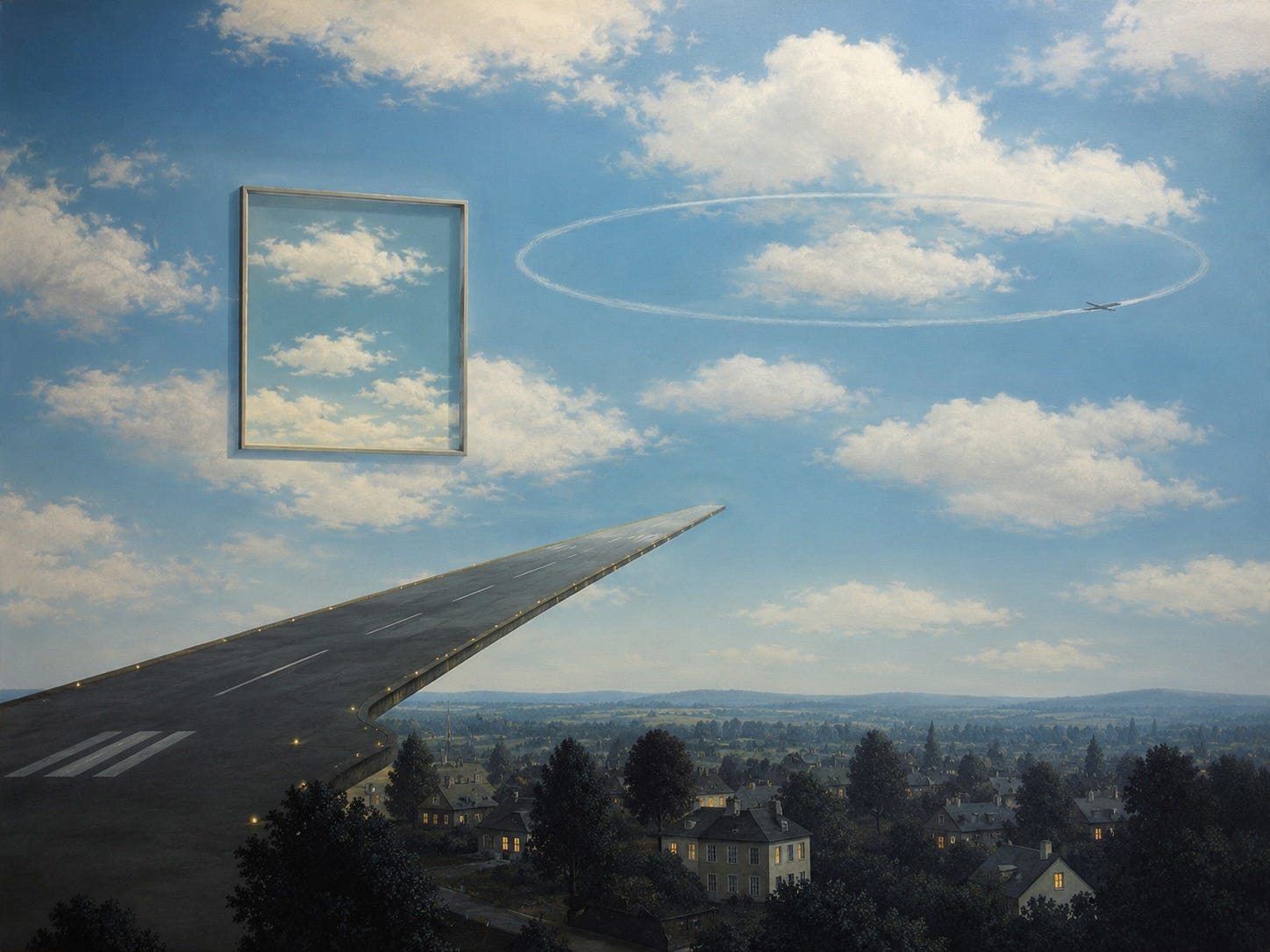
The runway is falling away.
At a lab in May,
more than four lines in five
of the codebase
were written by a model.
About every four months,
the work a system finishes solo
reaches twice as far.
No flight yet flies itself alone.
Still, the horizon keeps moving,
and the instruments are speaking.
For all it writes, the model
holds no seat, knows no home,
feels no weather in the towns it touches.
The question cannot end with it.
Every takeoff borrows
from a landing not yet made.
A runway kept clear,
an alternate kept open,
someone awake on the ground.
A holding pattern is an interval
flown on purpose. The map held in common,
each turn entered in the record,
the right to leave without losing home.
We hold the option, not the line.
Landing starts early,
long before wheels touch ground.
It starts wherever the weight will come down:
who, in this place,
is owed an answer when this system acts,
and who is authorised to give that answer?
Those who will carry the consequences
should help author the test.
A lab can read the engine
but not every town along the route.
A town can feel the weight
but cannot open the casing alone.
So, we need each other.
Instruments fine enough to verify,
neighbours with standing to decide.
One tells us whether the brakes will hold.
The other, who may pull them.
Takeoff is now.
So is the holding.
So is the landing.
Three duties of the same hour.
The faster the climb,
the more the flight owes the ground:
communities, each with a voice,
each with a way home,
each able to alter course.
Arrival, when it comes, will be plural.
A world still wild enough
to choose what lands,
what leaves,
what grows.
We arrive together, answerable,
or we do not arrive at all.